

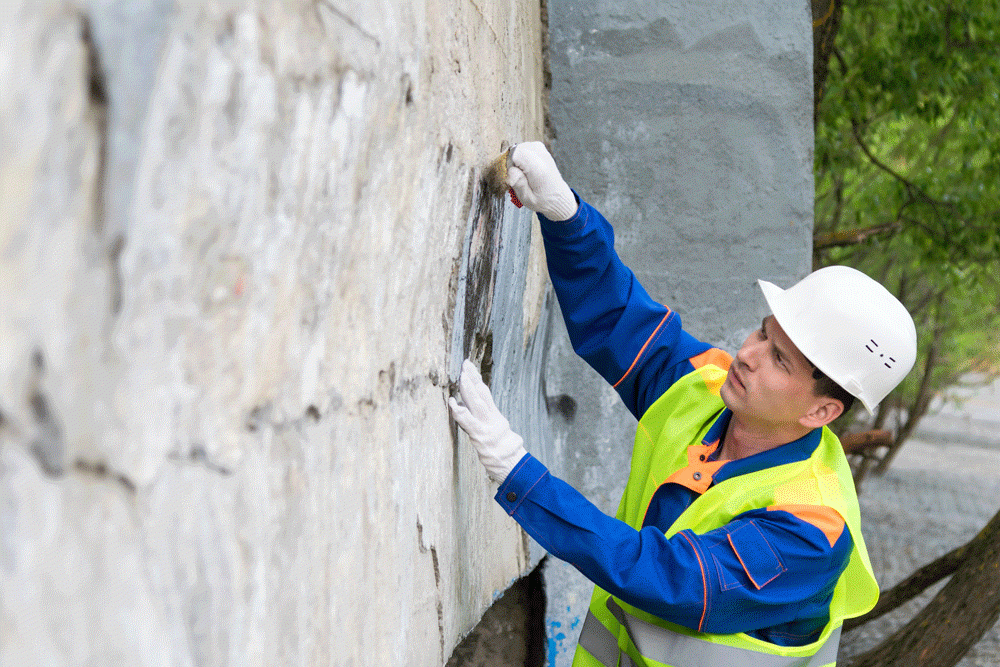
Abi Ademiluyi, principal advisor at APSE, outlines the operational, legal and resource challenges councils face in tackling graffiti and the emerging approaches shaping more effective responses
Graffiti remains a persistent environmental and anti-social issue across urban and rural authorities; it can impact perceptions of safety and place quality, community confidence, local business vitality and regeneration outcomes.Local authorities have statutory powers and operational duties relating to graffiti under environmental protection and anti-social behaviour legislation. Local authorities derive powers and duties from key legislation including the Environmental Protection Act 1990, Clean Neighbourhoods and Environment Act 2005, and Anti-social Behaviour, Crime and Policing Act 2014.
Under these frameworks, councils must maintain public land to an acceptable environmental standard, require landowners to remove graffiti that is detrimental to local amenity, issue Community Protection Notices (CPNs), serve defacement removal notices and take enforcement action for persistent non-compliance.
Councils are responsible for keeping public land and highways clear of graffiti where it affects environmental quality and are responsible for removing graffiti from council-owned assets, such as street furniture and council buildings, with most councils providing this service for free. Private property graffiti is usually the owner’s responsibility. However, councils may offer removal for a fee, recharge commercial property owners, serve notices requiring removal if it affects local amenity and undertake default works and recover costs if notices are ignored.
Offensive graffiti is often prioritised for removal within 24–48 hours and aligns with wider equality and community safety responsibilities.
Dedicated removal teams and blitz campaigns
Many councils deploy specialist cleansing teams or blitz operations targeting known graffiti hotspots. These often involve high-pressure washing, repainting or overcoating, and chemical solvent removal across streets and public infrastructure to reduce visual blight rapidly.
Southwark Council is adopting a proactive approach to tackling graffiti with four dedicated ‘blitz’ teams, launched in April 2025, focusing on hotspots in Peckham, Camberwell, and Elephant and Castle. The clean-up will include high-pressure jet-washing and repainting. As part of this initiative, the Council is investing £1.3 million over two years in tougher enforcement, new litter bins and creative deterrents like shutter art, wall murals, trellises, and planters to discourage vandalism. To encourage wider use of the Council’s free graffiti removal service, officers will be engaging with local businesses and residents to raise awareness of the offer.
Similar blitz-style programmes have been developed in Brighton and Hove City Council, focusing on quick removal, enforcement action, and a broader strategic tagging plan. This came off the back of a three-year Graffiti Tagging Action Plan laid out in 2024, designed to target the quick removal, enforcement and prevention of illegal tagging across the city.
In some cases, local authorities ring-fence resource for rapid removal once graffiti is reported, often using online reporting tools
to speed up response times. Some also implement proactive inspection and monitoring regimes to identify new tagging quickly. Enforcement and incentives go together, with councils increasingly pairing removal with enforcement and fixed penalty notices or enforcement action against offenders. In some cases, councils have also recharged large organisations or property owners for cleaning if they fail to maintain properties themselves.
Collaborative and pilot projects
Some authorities partner with stakeholders such as police, BID groups, and community organisations to map graffiti hotspots and coordinate efforts. For example, Cheltenham Borough Council worked with local policing teams and community groups on a targeted graffiti pilot.
Data and digital platforms are also being used to improve operational efficiency. Software solutions help digitise reporting, prioritise tasks, and allocate crews in real time, cutting down manual administrative work and improving response times.
Community prevention and engagement
Using community art projects, legal street art programming and behavioural change campaigns have also helped redirect tagging impulses into positive outlets and build shared responsibility for clean spaces.
Operational challenges facing councils
Councils face budget pressures and labour intensity; graffiti removal can be a significant cost for local authorities and the need to distinguish artistic expression from vandalism remain ongoing operational challenges.
Graffiti removal is resource-intensive, costly and often reactive. In larger urban areas, repeated tagging and rapid re-appearance place heavy demand on crews and equipment. Repeat tagging increases costs and diverts resources from other cleansing priorities. Removal from historic buildings, porous surfaces, bridges, and transport infrastructure requires specialist techniques. Graffition private assets can create visual blight but requires enforcement action before removal.
Intensive graffiti removal activity, particularly in high-footfall zones, can distract from other cleansing functions. For example, trials in Brighton showed daily removal demands impacted other operational workstreams, limiting scalability. In some instances, limited powers or bureaucratic delays can mean enforcement lags behind tagging incidents, weakening deterrence.
Councils have also had to balance responding to unwanted tagging while preserving community-valued street art. Policies are beginning to emerge that distinguish illegal tagging from recognised public art when deciding on removal action.
Emerging trends and innovations in removal techniques
Evidence suggests early removal reduces repeat tagging by removing visibility incentives. Councils are now evolving in the ways they deal with graffiti removal with removal technologies evolving beyond traditional harsh chemicals and solvent use.
Steam and water pressure systems are increasingly adopted for surface-safe, chemical-free removal. Hydrogel and biodegradable cleaning agents allow selective paint removal without damaging underlying surfaces, especially useful on sensitive or historic substrates.
Chelmsford City Council use a range of friendly chemicals specifically for heritage surfaces. Working with a company with a dedicated training depot where the attendees can get practical experience of the chemicals and various surfaces.
Another council has a contractor that feeds fine amounts of kiln-dried sand into a jet of water, making it very gently abrasive and lifts the paint off the sandstone surface. It works well for sensitive locations such as war memorials.
In some cases, councils have adopted Anti-Graffiti Surface Protection. Protective coatings and sealants that reduce paint adhesion make cleaning easier and less destructive. These are part of proactive management strategies to reduce long-term removal costs. These protective strategies aim to reduce long-term reactive costs, and also include legal mural schemes, youth diversion projects and business improvement district partnerships.
Although still emerging, and at the research and trials pilot stage, technological innovations like robot and sensor technologies using robotic systems for high-risk or hard-to-reach areas as well as sensor tech that detects new tagging and triggers alerts, potentially enabling even faster responses, could be part of the solution for future opportunities.
Summary
Graffiti removal is a high-visibility, high-effort service that significantly influences public perceptions of local environment quality. It remains a core environmental service responsibility for UK local authorities.
Councils continue to balance statutory duties, community expectations, and growing fiscal pressures while responding to frequent tagging incidents in both urban and suburban environments.
Local authorities are evolving beyond reactive patch-ups toward data-driven, preventative and community-oriented strategies. While budgetary and operational constraints remain key challenges, effective long-term outcomes are increasingly tied to integration of enforcement, prevention, and technology-enabled delivery, helping to deliver better outcomes.